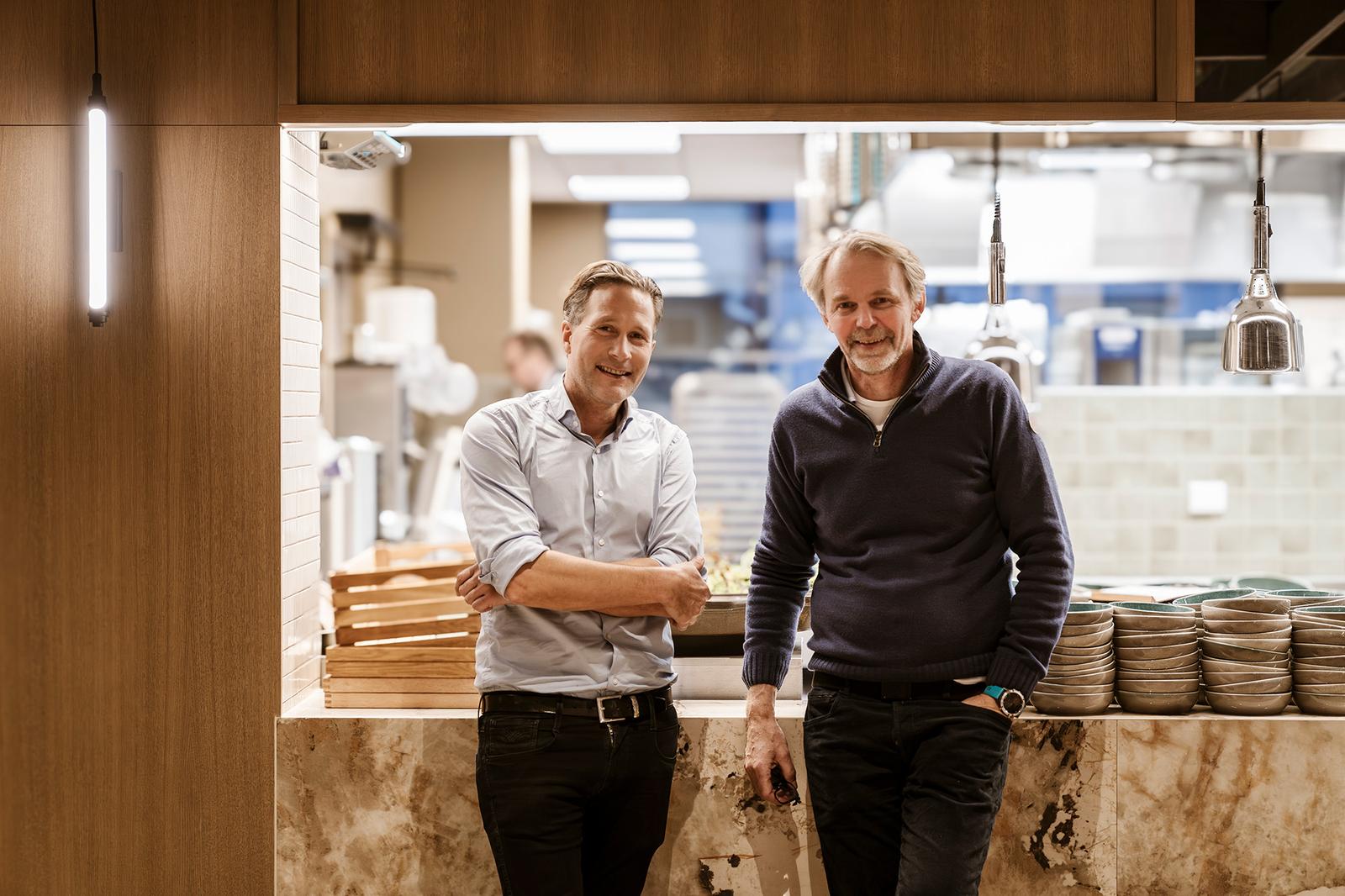
By 2030, players in the food service industry have a goal of halving food waste, and Norwegian canteens must do their part. If you don't use prediction in canteen operations, it will be difficult to operate sustainably, says Nikolai Halle, Nordic Sales Manager at Izy.
"Time flies. If we are to reach the goal of halving food waste and reducing CO₂ emissions, everyone must contribute and use tools that actually work. With prediction and use of AI, you can with up to 90 percent certainty say how many visitors will come to your canteen 30 days in advance and plan purchases accordingly. It also becomes easier to hit the right staffing levels," says Nikolai Halle from Izy. Reducing food waste can provide several benefits, also for property owners and investors.
"You can achieve more favorable property financing. The reason is that measures that reduce food waste can be classified as sustainable according to the EU taxonomy," explains Halle. The taxonomy classifies economic activities that the EU considers sustainable and contributes to green transformation in Europe.
"Measures, investments, and reporting on food waste contribute to achieving green financing and strengthened market position within the EU," he says.
Food waste is directly linked to UN Sustainable Development Goal 12, which is about responsible consumption and production, and specifically to target 12.3, which is about halving food waste. So if you have ambitions to operate sustainably, prediction is a no-brainer, emphasizes Halle.
While Norway lags behind in reducing food waste, both Sweden and Denmark have a completely different awareness around the issue and have succeeded in reducing the CO₂ footprint caused by throwing away food. In Norway, we actually emit twice as much CO₂ per capita compared to Sweden.
In 2022, we threw away approximately 450,000 tons of edible food, according to Matvett. A significant portion comes from Norwegian commercial kitchens and canteens. A full 20 percent of food from there is thrown away, according to figures from the Nordic Council of Ministers.
"When food is prepared for an average of 200 people in over 4,000 Norwegian canteens daily, the amount of waste becomes enormous. With prediction, canteens are able to permanently reduce food waste and contribute to significantly lowering their carbon footprint," says Halle.
"Prediction can seem like a technical and complex process, but simply put, it's about using data from previous periods to make good assumptions about the future," explains Ole Aabel, CVO at Izy AS and one of the people behind the Norwegian tech company Izy. They have developed the Izy app, which is used in a number of commercial buildings for canteen payment, kiosk, meeting room booking, and meeting food ordering. Transaction data from the app is collected and used as a prediction basis.
"With prediction, the canteen has the opportunity to plan the number of portions more precisely, which helps reduce overproduction and food waste. We have made it easy for our customers to use the data to improve canteen operations without needing an advanced technical background," he explains.
"By using advanced prediction models and a unique CO₂ dashboard, we give our Facility Management (FM) customers a tool that not only predicts visitor numbers but also shows how they can significantly reduce their carbon footprint," explains Ole Aabel.
For Izy, it doesn't stop at predicting canteen visitor numbers. A new and unique CO₂ dashboard has been developed to calculate the canteen's carbon footprint. The calculation is based on several factors, including energy use, menu choices, food waste, and resource usage.
"The dashboard is a management tool that enables the canteen to actively work toward achieving the UN's emission targets and thus control their environmental footprint. In an industry where such tools are not standard, our CO₂ dashboard will give FM customers the opportunity to integrate sustainability into daily operations in a way that was previously not possible," explains Aabel. The CO₂ dashboard highlights what can be done for more sustainable operations. For example:
"We want to use AI, and the opportunities it gives us, to develop smart and sustainable solutions that contribute to a better world. AI is used for a lot of strange things today, and one might suspect that some claim AI technology even though it's really just a slightly advanced Google search," says Nikolai Halle.
"Together with our customers in canteen operations, we will make a real difference. For us, it's about making canteen operations sustainable, efficient, and climate-friendly. And you can start today! Within 1-2 weeks, you can get enough data to start with prediction in your canteen operations," he emphasizes.
...approximately 450,000 tons of edible food was thrown away in Norway in 2022, including from canteens.
...20 percent of food prepared in canteens and commercial kitchens ends up as waste?
...Norway has committed to halving food waste by 2030?
...food waste is an important area for businesses that want to adapt to the EU taxonomy and achieve green financing or better market position within the EU?
...food waste is directly linked to UN Sustainable Development Goal 12, which is about Responsible Consumption and Production.
Send us an inquiry through the form, and one of our customer advisors will contact you as soon as possible!
Or click the link below and book a meeting directly in the calendar.