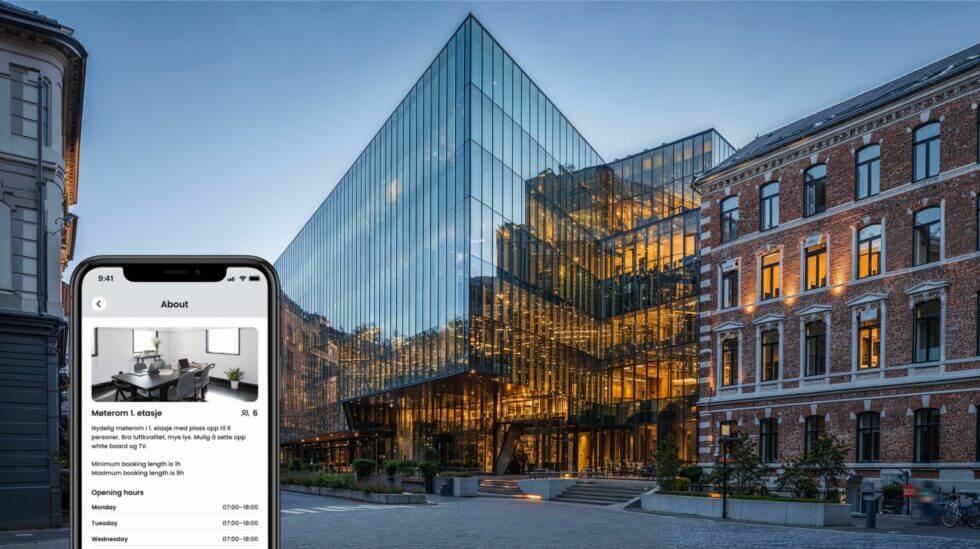
At 07:45, Sveinung walks towards the main entrance at work. The app in his pocket communicates automatically with the office building, and the door opens before he reaches out his hand. The light in his office turns on when he passes the sensor in the hallway, and the air conditioner adjusts the temperature to his preferred 22 degrees.
In the elevator, he sees on his phone that meeting room B is available at 10 a.m., and books it with one keystroke. The canteen has already been told that 127 people will come for lunch today - not 95 as yesterday, or 156 as on Monday. Therefore, they have made just the right amount of food.
When Sveinung leaves the building at 4:30 p.m., the light in his office is automatically dimmed. Sensors detect that there are no more people on his floor, and ventilation is reduced to a minimum. The building gradually “falls asleep” as the last ones go home.
This is proptech in practice - technology that makes everyday life smoother for Sveinung, saves money for the farm owner, and reduces the environmental footprint of the building.
Proptech at 1-2-3
What: Property Technology - technology meets property.
How: Sensors, apps, AI and digital platforms.
Why: Save money, reduce environmental footprint, improve user experience.
Proptech combines real estate and technology. The term is used for all uses of information technology in the real estate industry. It encompasses everything from digital tools for buying and selling property, to smart solutions for operating business buildings. In practice, start-up companies and new business models are often aimed at challenging the traditional real estate industry with innovative products.
Proptech can be seen as the real estate industry's answer to fintech (finance). It is a digital transformation where technology meets property to create more value for both owners, managers and users of business buildings. In other words, proptech covers all new digital tools being adopted to make real estate easier, more affordable, safer and more user-friendly.
Machine learning that analyzes building data to predict energy consumption, optimize climate management, and notify about maintenance needs before failures occur. Examples: AI that learns usage patterns and adjusts heating automatically, or image recognition that identifies food in canteen boxes for faster payment.
Sensors and devices connected to the internet that collect data from the building in real time. Examples: Temperature sensors that automatically adjust the air conditioning, motion sensors that turn on lights when someone arrives, or air quality meters that regulate ventilation based on CO₂ levels.
Proptech has in recent years gone from being niche to becoming mainstream in real estate. Globally, the proptech sector is growing strongly. The sector was valued at around 35-40 billion USD in 2024 and is expected to triple to over 100 billion by 2032. Despite a general decline in venture capital, US$42 billion found its way to proptech investments in 2023.
Artificial intelligence (AI) and the Internet of Things (IoT) are driving much of this growth. These technologies enable everything from predictive maintenance and personalized indoor climate to smart energy management and automated operations. As many as 70% of proptech investments now have an AI element, and 3 out of 4 new commercial buildings come fully equipped with IoT sensors.
In the Nordic countries, and especially Norway, we see a strong emphasis on sustainability and user experience. Proptech solutions here in the country often focus on green technology, energy conservation and creating great experiences for tenants.
Daniel Butenschøn at Proptech Norway points out that Norwegian and Nordic proptech keeps high quality and asserts itself internationally, despite less funding the level of innovation is high. A good example is that several Norwegian startups have won awards in the Nordic PropTech Awards.
In 2024 won Stavanger company PowerPal for its smart energy management solution that optimizes power consumption and emissions. In the same year, he won Bergen-based Carrot in the Property Management category with a solution that uses real-time data to motivate tenants for better recycling, to the benefit of both the environment and the farm owner's costs.
Such successes illustrate how Nordic proptech players are at the forefront especially on sustainable buildings, while delivering bottom-line value. Another trend in the Nordic region is the cooperation between established real estate companies and technology companies.
The industry network Proptech Norway brings together entrepreneurs, real estate operators and investors precisely to share insights and promote sustainable development of buildings and cities. Proptech has gone from “nice to have” to must-have also in our part of the world, and both public and private initiatives are helping to scale new solutions.
Proptech encompasses a number of technologies, but some stand out as particularly central:
Smart sensors connected to the internet make buildings “digital” by gathering data on everything from temperature, air quality and energy consumption to movement and access. This data is then used to control the builds automatically. For example, sensors and automation systems can adjust lighting and ventilation in real time according to whether people are present. Such smart buildings optimize operation - they save electricity and adapt the environment for better comfort.
IoT devices also enable predictive maintenance: by monitoring vibration, temperature, water pressure, etc., the system can anticipate failures before they occur. Thus, one can replace a part in an elevator or a ventilation system before an outage occurs. This reduces unforeseen downtime by up to 50% and maintenance costs by 20-25%. IoT is thus the foundation of proptech - the data collection that makes the building smart.
For a deeper understanding of how technology is changing the workplace, we recommend whitepaper “The Digital Workplace 2025” - a thorough review of the trends shaping the future office environment.
AI is at the core of many proptech solutions. Using machine learning, systems can analyze large amounts of data from sensors and equipment, find patterns and make predictions. One example is predictive analytics for building operations: AI can learn the usage pattern in a building and predict how many people will be present on a given day or hour.
Such forecasts make it possible to plan cleaning, safety, heating and even canteen operation more precisely. In practice, this means everything from lower electricity bills (you heat/cool only when needed) to less food waste in the canteen (you cook the right amount of food). Izy, for example, has tested AI models that manage to predict the number of people in the building with ~95% hit safety a few weeks ahead in time. This provides a basis for cutting energy and food waste considerably - sustainability solutions driven by data.
AI is also used for advanced security (e.g., facial recognition for access control) and to optimize land use (e.g., analyze office space usage and suggest better layout). Moreover, with generative AI, we see that chatbots and smart assistants can provide tenants with information or handle inquiries automatically. All in all, AI provides insights from building data and makes buildings proactive rather than reactive.
Another key innovation in proptech is the emergence of digital platforms that connect people and services in construction. This includes mobile apps for tenants, web portals for property managers and interaction systems for operations personnel. Such platforms serve as the central platform of a building - a place to book meeting rooms, report service needs, get news from farm owners, manage visitor access and much more, all in one solution.
Today, tenants expect “everything exists as an app” - for them to be able to use the build as seamlessly as a smartphone. This has made tenant experience platforms the central hub of the building: An app/portal brings together all services in one easy-to-use solution. Examples include an app where you can buy lunch in the cafeteria, lock yourself in the office, reserve a bike parking space and chat with the reception desk.
For the farm owner, the platform means that you get a direct communication channel out to everyone in the building (no more notices on the door or emails that are not read). For service providers (such as cleaning, canteen, janitor), it means easier logistics and shared tools - they can plan and deliver their services more efficiently. Digital platforms are simply the hub where the proptech threads congregate.
Sustainability runs like a common thread through modern proptech. Building accounts for a significant share of energy consumption and emissions, so the technology is aimed at making buildings greener. This includes everything from energy optimization (smart management systems as mentioned above) to solutions for waste management and reuse.
A proptech company like Carrot, for example, focuses on increasing recycling rates in buildings using digital motivation. Other innovations include the materials bank (digital marketplaces for the reuse of building materials), water and heat consumption sensorics with direct feedback to users, and reporting tools for ESG data (environmental, social and governance parameters) related to building.
Green proptech helps owners meet stringent climate and environmental requirements while often providing cost savings. A concrete example: Transition to demand-driven operation of buildings (e.g. ventilation and lighting are only on when needed) has been shown to Cut energy consumption by around 25% and pays off in under a year when electricity prices are moderate. In other words, Proptech turns sustainability into good business, by uniting green goals with financial gain.
Read more about Proptech next week in part 2.