IN part 1 of our proptech series we learned about the technologies that make office buildings smart: IoT sensors, artificial intelligence, digital platforms and sustainability solutions. But how are these technologies applied in practice? How much difference do they really make?
Let's look at the most important applications of proptech in Norwegian office buildings and facility management (FM).
Modern office buildings are equipped with smart control systems that can adjust light, ventilation and heating automatically based on sensor data. When sensors detect that a meeting room is empty, the light is dimmed and ventilation is reduced. When people return, the environment adapts again.
This provides better comfort for those who work there and reduces energy consumption when the premises are empty. Many office buildings report 20-30% lower energy bills after installing such technology.
Traditionally, office building maintenance has been calendar-driven (“we check the elevator every three months”) or reaction-based (“we fix it when it smokes”). With proptech, this changes to proactive operation.
Sensors on equipment such as elevators, ventilation systems and pumps continuously monitor its condition. AI models analyze the data and can alert before a component fails. For example: increased vibration in an elevator motor may indicate wear, and then the operating department may change the part before the elevator stops.
The result:
Automated lighting, ventilation and heat adjust to sensor data — while AI models use vibration, temperature and power consumption to notify of errors before they occur.
Examples: System that dims lights in empty zones, or elevator motor that switches before it stops.
Gain: 20-30% lower energy consumption and up to 25% lower maintenance costs.
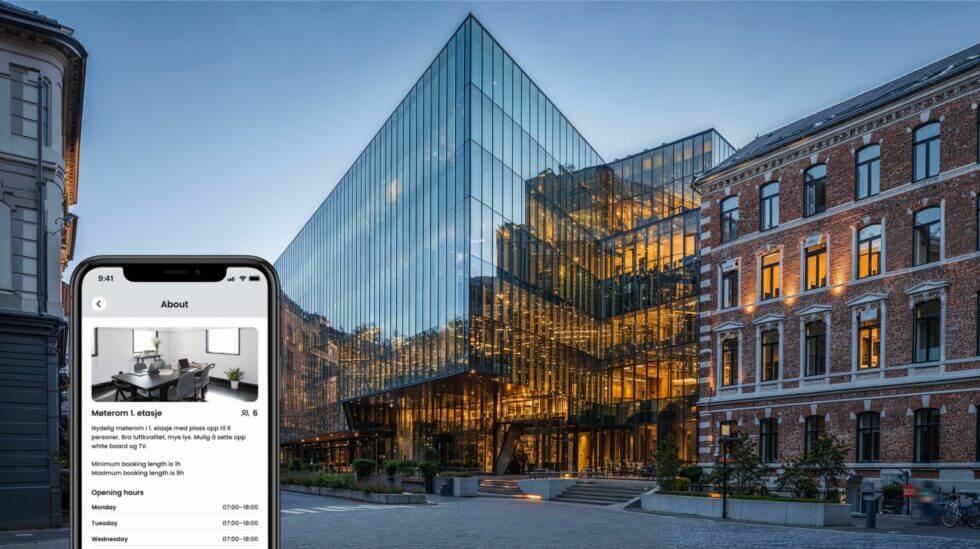
One app lets employees book meeting rooms, book lunch and register guests in seconds. Sensor and booking data show actual use of the office, so the building can be adapted to hybrid work.
Examples: Push notification of scheduled maintenance, desks-booking that releases free space, live numbers for canteen rush.
Gain: More satisfied tenants and 10-15% better land use
In modern office buildings, tenant apps are becoming increasingly common. These act as a “remote control” for the office building, where employees can:
For farm owners, the app provides direct communication with all tenants. Push notifications about maintenance work, surveys about well-being, or news about the office building arrive instantly - no more notifications on the door that go unread.
Hybrid modes of work have increased the need to manage land use smartly. Proptech solutions in space management allow companies to monitor how office space is actually used.
Sensor data can show, for example, that:
This information is used to optimize layout, adjust rental conditions or plan better. Desk boss apps allow employees to book work space for the day if the company has flexible workplaces, and gives the administration an overview of how many people are actually using the office.
Proptech has also changed the way properties are bought, sold and managed:
These solutions make property everyday life more streamlined and reduce time spent on paperwork.
Norway has established itself as a significant player in proptech, with several companies providing solutions in use worldwide:
Established successes
Airthings (Oslo): World leader in IoT sensors for indoor climate and air quality in office buildings
Spacemaker (now part of Autodesk) (Oslo): AI platform for building optimization, sold to Autodesk for billions
Growing players
Izy, Oslo: Holistic platform that brings together all office building services - from meeting room booking to AI-powered canteen payments - in one solution
PowerPal (Stavanger): Smart energy management that optimises electricity consumption and reduces emissions
Carrot (Bergen): Motivating tenants to better recycle through real-time data
These companies show the breadth of Norwegian proptech - from hardware and sensors to AI and digital platforms.
For farm owners and facility managers, proptech means access to a toolkit of digital aids that can:
Cutting costs: Lower energy bills and maintenance costs
Raising incomes: Satisfied tenants renewing contracts
Improve service: Faster response to problems and better communication
Proptech finds application throughout the entire life cycle of a property - from planning and construction to operation and service. What was once “nice to have” has now become a necessity to compete in the real estate market.
In the next part of the series, we look at a concrete example: How the Norwegian company Izy has brought together the proptech principles into one comprehensive platform.
Read more about Proptech and Izy in part 3.