Text: Saurav Pandey
Over the past two decades, only 1501 new offices and commercial buildings have appeared on the Norwegian market. We were surprised to find out that this number is so low. In an era of rapid technological progress, one might expect a boom in commercial construction, but this stagnant growth seemed like an anomaly that prompted us to take a deep dive into the underlying factors.
We had a suspicion that technology, or lack thereof, played a significant role in this downturn, but the story played out a little differently when we decided to dig deeper.
Figure: Stable number of new commercial buildings in Norway over time. Source: ssb.no (Statistics Norway)
First, Norway's strict regulations prioritize sustainability and energy efficiency. All new commercial buildings must meet strict standards under the Technical Regulation (TEK17) that are in line with EU regulations that aim to achieve fully decarbonised buildings by 2050. Given that barley accounts for roughly 40% of all energy consumption in the EU, it has become a highly regulated area. From 1 January 2027, all new buildings occupied or owned by public authorities must meet NZEB (almost zero-energy buildings) standards. This change introduces the concept of 'brown discount', a decrease in demand from tenants due to non-compliance with green regulations, which can contribute to this stagnation in the growth rate.
Energy efficiency affects every aspect of a building ecosystem. From how environmentally friendly the building is constructed, how efficiently the building's trustees maintain it, how service providers deliver their services in the building, to how responsibly the tenant consumes those services. Everything counts. Our solution, Izy portalcreates an ecosystem so that it brings together all these parties in one platform where one has one place to manage all aspects of the business building, while saving time and resources. In addition, our prediction platform helps make computer-based decisions about future sales to manage the supply chain accordingly. In this way, clean operation with green energy will strongly influence how the future of a commercial property in Norway will be.
Figure: Breakdown of weekly orders in the Izy platform. Source: Data from the IZY platform
Then comes technology. Norway's adoption rate of electric cars, which accounted for 82.4% of all new passenger car sales in Norway in 2023, underlines the national affinity for technology and innovation. Smart homes and smart buildings have become the core of Norwegian culture. At Izy, we promote this with MaiFood, a smart checkout system powered by artificial intelligence. The future also depends on how Facility management platforms can integrate Large Language Model (LLMs) and other generative AI applications to enhance the tenant experience.
Finally, we have looked at how the post-pandemic work culture has moved towards home office or hybrid work, the already increasing work-life balance, adds to the challenge of user satisfaction that service providers must take into account. Honestly, there aren't many of us who want to sit in our offices on a warm summer day which is already rare commodity in Scandinavia after a long winter.
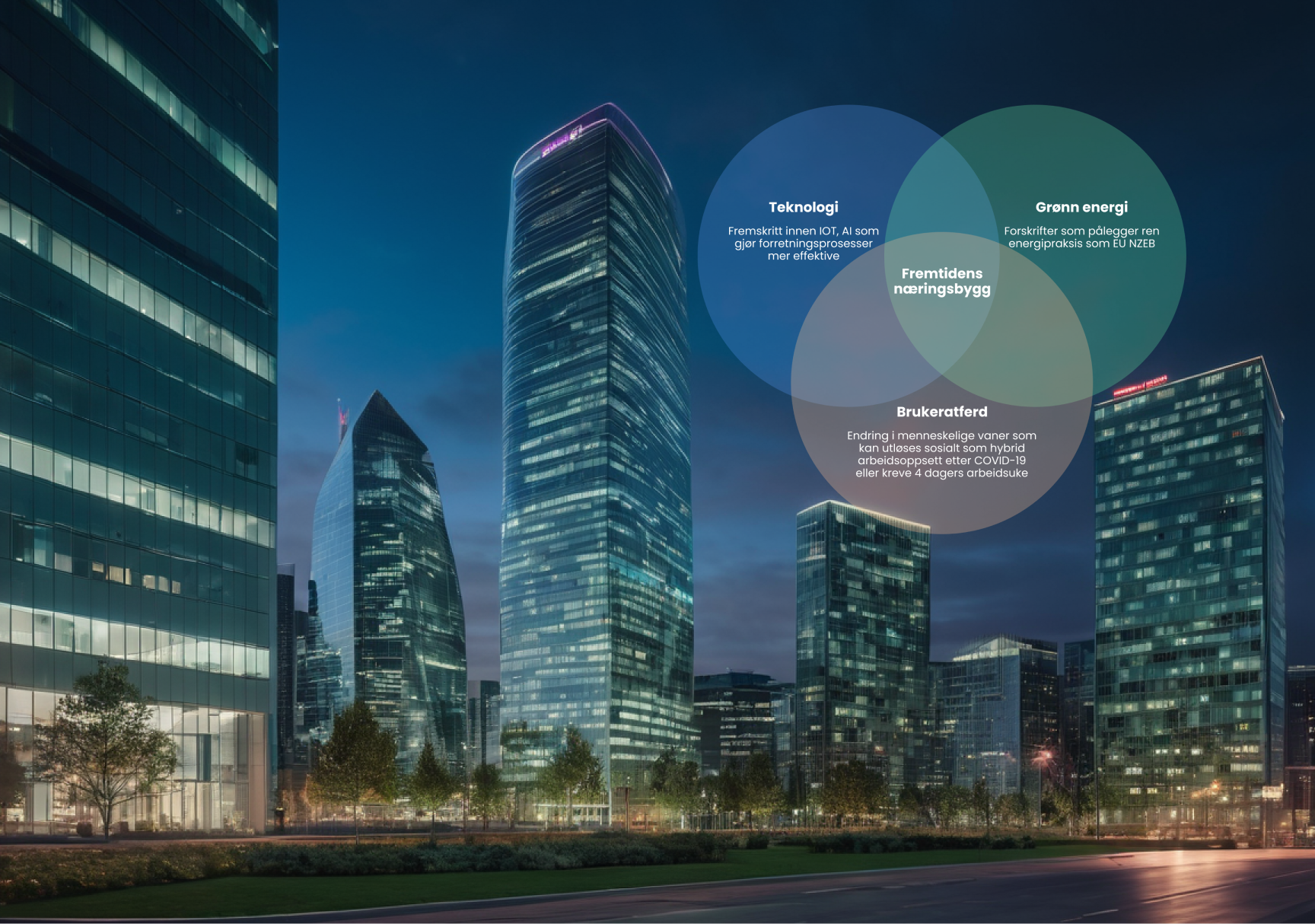
To summarize this insight, we believe that the future of commercial real estate in Norway will be shaped by three important forces: green energy, technology and changing user behaviour. Technology, along with improving the building's operation, also affects tenants' expectations. With growing concerns about climate action, the source of energy to power the innovative technology is just as important and tenants' behaviour is often controlled by technology. We believe that the future of commercial real estate lies somewhere between the triad of technology, green energy revolution and shift in user behaviour as consumers of the services.
This article was originally written in English and has been translated into Norwegian, read the original article here